In this story
-
Circe's warning
As Odysseus leaves her island, Circe tells him of the dangers ahead. First he will reach the Sirens, who sit in a meadow of flowers surrounded by heaps of the bones of rotting men. Whoever hears their song never sees his wife and children again.
She tells him what to do: stop his men's ears with wax. If he wants to listen himself, he must be tied hand and foot to the mast, and if he begs to be released, his men must bind him tighter.
Homer, Odyssey 12.37–54 -
The song
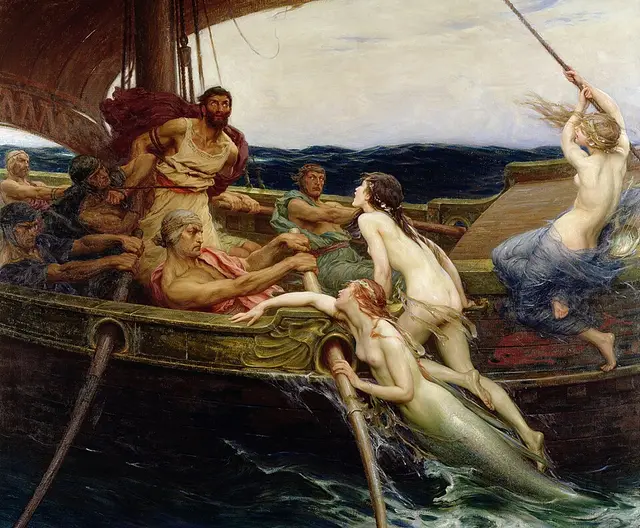
As the ship nears the Sirens' island the wind drops and the sea falls calm. Odysseus cuts a cake of wax with his sword, kneads it soft and seals his men's ears. They tie him to the mast and row on.
The Sirens call out: come here, famous Odysseus, stop your ship and listen to our voices. No one has ever sailed past without hearing the honey-sweet song from our lips, and gone on his way delighted and wiser. We know all that the Greeks and Trojans suffered at Troy, and everything that happens on the earth.
Odysseus signals with his brows for his men to untie him, but Perimedes and Eurylochus get up and bind him tighter. Only when the song has faded do they take the wax from their ears and release him.
Homer, Odyssey 12.158–200 -
Orpheus's lyre
One other ship passed the Sirens safely: the Argo. As the Argonauts approached, Orpheus played his lyre to drown out their voices. Only Butes could not resist and leapt into the sea, but Aphrodite snatched him from the waves.
Apollodorus says the Sirens were fated to die if a ship sailed past them unharmed, and that they died when Odysseus passed. He also names them: Peisinoe, Aglaope and Thelxiepeia; one played the lyre, one sang and one played the pipes.
Apollonius of Rhodes, Argonautica 4.891–921; Apollodorus, Epitome 7.18–7.19 -
Birds with women's heads
In ancient art the Sirens are not fish-tailed mermaids but birds with the heads of women. Ovid explains why: they had been companions of Persephone, and when she was carried off they asked for wings so they could search for her over the sea too, and the gods granted their wish.
In the Middle Ages the Sirens were confused with mermaids, and in many languages 'siren' still means a mermaid.
Ovid, Metamorphoses 5.552–563
Ancient sources
- Homer, Odyssey 12.37–54, 12.158–200
- Apollonius of Rhodes, Argonautica 4.891–921
- Apollodorus, Epitome 7.18–7.19
- Ovid, Metamorphoses 5.552–563