Bird-women whose irresistible song lures sailors to their death. Odysseus hears it tied to the mast; Orpheus drowns it out with his lyre.
In brief
- In the Odyssey they sit in a flowery meadow surrounded by heaps of rotting human bones. Whoever listens to their song forgets to go home.
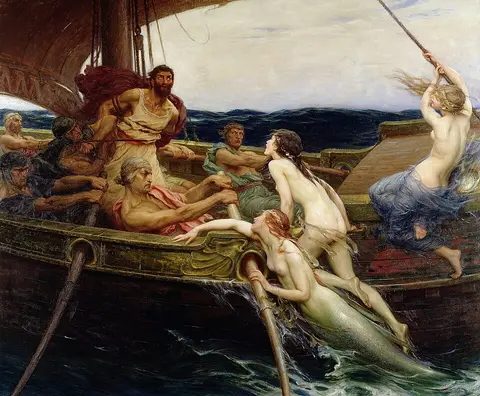
- On Circe's advice Odysseus plugs his men's ears with beeswax and has himself tied to the mast. The Sirens promise him that they 'know everything', including all that happened at Troy.
- Apollodorus says they are daughters of the river god Achelous and a Muse.
Family
Parents
Apollodorus, Epitome 7.18
Siblings
½ Half-sibling: only one parent in common.
To see the whole family, open the Sirens family tree → · how is Sirens related to Zeus? → · compare with someone else →
Against Orpheus
As the Argonauts sail past the Sirens' island, Orpheus plays his lyre and drowns out their song. Only Butes can't resist and leaps into the sea; Aphrodite rescues him. A later story says the Sirens were fated to die if anyone heard their song and survived.
Apollonius of Rhodes, Argonautica 4.891–921From bird to fish
On ancient vases and grave statues Sirens are birds with women's heads. In the Middle Ages they became confused with fish-tailed mermaids, and in many languages 'siren' still means mermaid. The warning siren is named after them too: the French physicist Cagniard de la Tour gave the name to the sound-making device he invented.
Sirens in art
14works depicting Sirens, in date order, from ancient vases to paintings of the Renaissance and after. All are in the public domain or openly licensed. Click an image for the full-size version and licence details. For scene-by-scene readings of famous vases, see Greek vase painting.


Stories featuring Sirens
Quick questions
- Who are Sirens' parents?
- In the main account, Sirens' father is Achelous and mother is Melpomene. Apollodorus, Epitome 7.18
- What are Sirens' symbols?
- Bird's body, Lyre and aulos.
- Which myths is Sirens in?
- Odysseus and the Sirens.
Ancient sources
This page is based on the texts below. Numbers refer to books and lines.
- Homer, Odyssey 12.37–54, 12.158–200
- Apollonius of Rhodes, Argonautica 4.891–921
- Apollodorus, Library 1.3.4; Apollodorus, Epitome 7.18–7.19