The six-headed sea monster who snatches six of Odysseus's men from the deck. 'Between Scylla and Charybdis' means caught between two dangers.
In brief
- In the Odyssey she has twelve feet and six long necks, each ending in a terrible head with three rows of teeth. Her voice is like the yelp of a newborn puppy.
- Across the strait, Charybdis swallows the sea three times a day and spits it back three times.
- Circe tells Odysseus it is better to give Scylla six men than to lose the whole ship to Charybdis. And Scylla does snatch six of his men.
Family
Parents
Homer, Odyssey 12.124–125
Apollonius of Rhodes, Argonautica 4.828–829
To see the whole family, open the Scylla family tree → · how is Scylla related to Zeus? → · compare with someone else →
In Ovid, a beautiful nymph
Ovid says Scylla was once a beautiful nymph. The sea god Glaucus falls in love with her and asks the sorceress Circe for help, but Circe, in love with Glaucus herself, jealously pours poisonous herbs into the water where Scylla bathes. Below the waist Scylla turns into a pack of barking dogs.
Ovid, Metamorphoses 13.730–14.74Between Scylla and Charybdis
Ancient writers usually placed Scylla and Charybdis in the Strait of Messina between Italy and Sicily. In English, being 'between Scylla and Charybdis' means having to choose between two dangers, much like 'between a rock and a hard place'.
Strabo, Geography 1.2.36Scylla in art
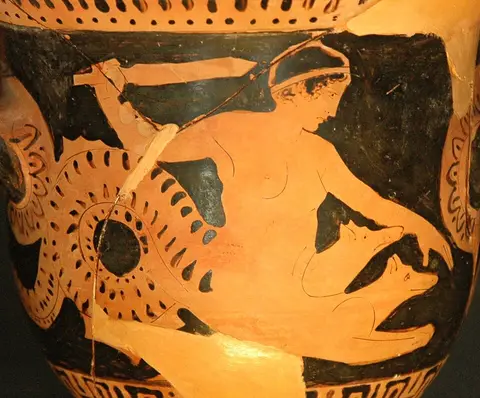
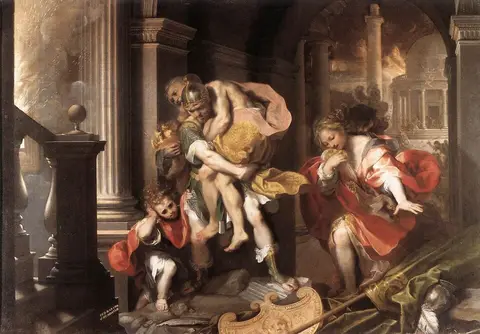
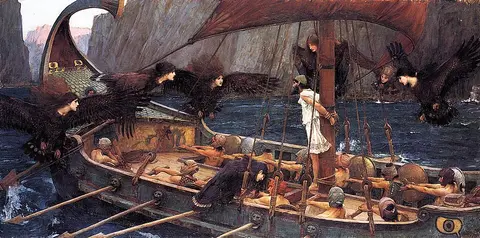
8works depicting Scylla, in date order, from ancient vases to paintings of the Renaissance and after. All are in the public domain or openly licensed. Click an image for the full-size version and licence details. For scene-by-scene readings of famous vases, see Greek vase painting.


Stories featuring Scylla
Quick questions
- Who are Scylla's parents?
- In the main account, Scylla's mother is Crataeis. The father is not named in this account. Other accounts name other parents; the family box above lists them all with their sources. Homer, Odyssey 12.124–125
- What are Scylla's symbols?
- Six heads, Dogs.
- Which myths is Scylla in?
- Glaucus and Scylla: beauty turned monster · The journey of Aeneas: from Troy to Rome · The return of Odysseus.
Ancient sources
This page is based on the texts below. Numbers refer to books and lines.
- Homer, Odyssey 12.73–126, 12.222–259
- Ovid, Metamorphoses 13.730–14.74
- Apollonius of Rhodes, Argonautica 4.789–832