The daughter of Oedipus. Defying the king's ban, she buries her brother who died in battle, and argues that the law of the gods stands above the king's command. She pays with her life.
In brief
- The daughter of Oedipus and Jocasta, and the sister of Eteocles, Polynices and Ismene.
- She guides her blind father in exile and stays with him until his death at Colonus, near Athens.
- When her brothers kill each other fighting for the throne of Thebes, King Creon forbids anyone to bury Polynices, who attacked the city. Antigone secretly covers her brother's body with earth.
Family
Consorts and partners
To see the whole family, open the Antigone family tree → · how is Antigone related to Zeus? → · compare with someone else →
The unwritten laws
In Sophocles' tragedy Antigone tells Creon that a king's decree cannot override the 'unwritten and unshakeable' laws of the gods. Those laws were not made yesterday or today; they have always been.
Creon has her walled up alive in a cave, where she hangs herself. Her fiancé Haemon, Creon's son, kills himself, and then so does Haemon's mother Eurydice. Creon is left alone with his remorse, too late.
Sophocles, Antigone 450–470, 773–776, 1192–1243, 1278–1316Antigone through the centuries
Antigone has been rewritten countless times as the symbol of conscience against the law of the state. Hegel considered her story the most perfect of tragedies. In 1944 Jean Anouilh staged his own Antigone in Paris under Nazi occupation.
Hegel, Lectures on Aesthetics; Jean Anouilh, Antigone (Paris, 1944)Words of Antigone
“I was not born to share in hatred, but to share in love.”
Our own plain translations: they keep the sense, not the exact words. Play “Who said it?” →
Antigone in art
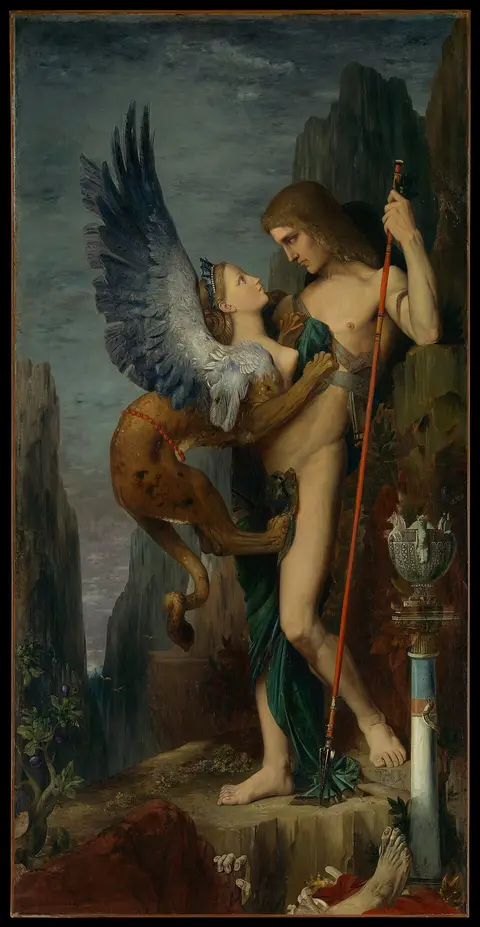
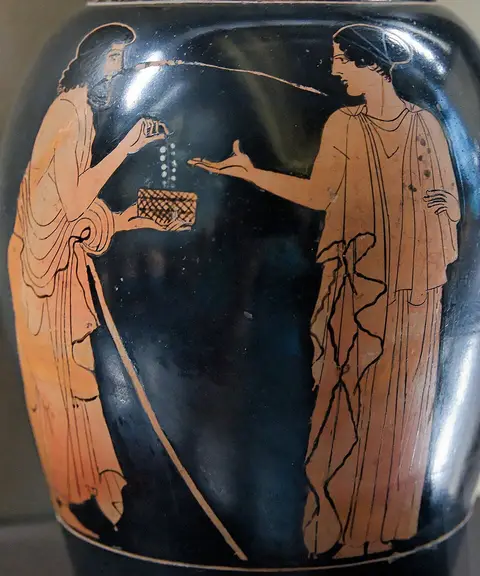
9works depicting Antigone, in date order, from ancient vases to paintings of the Renaissance and after. All are in the public domain or openly licensed. Click an image for the full-size version and licence details. For scene-by-scene readings of famous vases, see Greek vase painting.


Stories featuring Antigone
Quick questions
- Who are Antigone's parents?
- In the main account, Antigone's father is Oedipus and mother is Jocasta. Apollodorus, Library 3.5.8
- Who were Antigone's consorts and lovers?
- The partners named in the sources: Haemon.
- What are Antigone's symbols?
- A handful of earth.
- Which myths is Antigone in?
- The curse of Thebes: from Cadmus to Oedipus · The Seven against Thebes and the Epigoni.
Ancient sources
This page is based on the texts below. Numbers refer to books and lines.
- Sophocles, Antigone
- Sophocles, Oedipus at Colonus
- Aeschylus, Seven against Thebes 1005–1078
- Apollodorus, Library 3.7.1