The Seven against Thebes and the Epigoni
The sons of Oedipus cannot share the throne. The exiled Polynices marches on Thebes from Argos with an army of seven commanders. The war ends with the two brothers killing each other. Ten years later their sons, the Epigoni, achieve what their fathers could not.
In this story
-
The lion and the boar
Polynices and Eteocles agree to rule Thebes in turn, one year each. When his year is up, Eteocles will not give up the throne, and Polynices goes to Argos.
That same night Tydeus, an exile from Calydon, also arrives at the palace of Argos. The two strangers start fighting at the door. King Adrastus remembers a prophecy that he would marry his daughters to a lion and a boar, and these are the beasts on their shields. He gives Argia to Polynices and Deipyle to Tydeus, and promises to restore both to their thrones.
Apollodorus, Library 3.6.1 -
The necklace of Harmonia
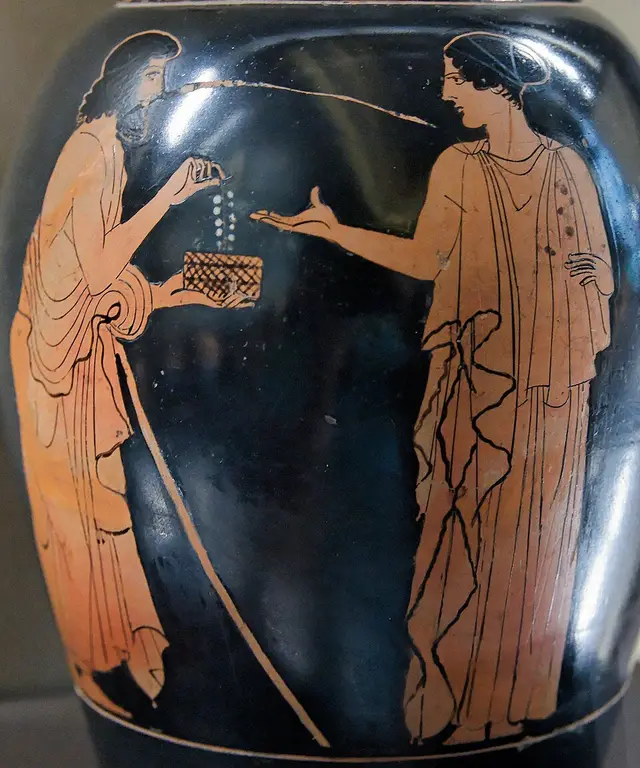
The seer Amphiaraus knows the expedition will end in disaster. But he has sworn to abide by his wife Eriphyle's decision in any dispute. Polynices gives Eriphyle the wedding gift that his ancestor Cadmus received from the gods, the necklace of Harmonia, and Eriphyle sends her husband to war.
Before he leaves, Amphiaraus orders his sons, when they are grown, to kill their mother and march on Thebes again.
Apollodorus, Library 3.6.2; Homer, Odyssey 11.326–327 -
The baby at Nemea
On the way the army runs out of water. At Nemea a slave nurse, the former queen of Lemnos Hypsipyle, shows the commanders where to find it. She puts down the baby Opheltes, who is in her care, for a moment, and a snake kills him.
Amphiaraus says this is a bad omen. They name the baby Archemorus, 'beginning of doom', and hold funeral games in his memory. These are counted as the origin of the Nemean Games.
Apollodorus, Library 3.6.4; Euripides, Hypsipyle (fragments) -
Seven gates
The seven commanders are Adrastus, Amphiaraus, Capaneus, Hippomedon, Polynices, Tydeus and Parthenopaeus, son of Atalanta. Each attacks one of the gates of Thebes. To save Thebes, Creon's son Menoeceus throws himself from the walls.
Capaneus sets a ladder against the walls and shouts that not even Zeus can stop him. Zeus strikes him with a thunderbolt.
Tydeus is badly wounded by Melanippus. Athena is about to bring him immortality. But Amphiaraus, who hates Tydeus, gives him the severed head of Melanippus. Tydeus splits it open and eats the brain. Seeing this, Athena is disgusted and withholds her gift.
Polynices and Eteocles meet in single combat and kill each other. As Amphiaraus flees, Zeus splits the earth with a thunderbolt and it swallows him with his chariot and charioteer. Later an oracle is founded in his name at Oropus. Of the seven commanders only Adrastus escapes, on his immortal horse Arion.
Apollodorus, Library 3.6.6–3.6.8; Aeschylus, Seven against Thebes; Euripides, Phoenician Women -
The unburied dead
Creon forbids the burial of Polynices and the Argives. Antigone secretly sprinkles earth on her brother's body and is walled up alive.
In Euripides' Suppliant Women the mothers of the dead take refuge in Athens. Theseus marches on Thebes and sees that the bodies are buried. Evadne, wife of Capaneus, leaps onto her husband's burning pyre.
Sophocles, Antigone; Euripides, Suppliant Women; Apollodorus, Library 3.7.1 -
The Epigoni
Ten years later the sons of the fallen commanders, the Epigoni ('those born after'), march on Thebes. Their leader is Alcmaeon, son of Amphiaraus. Among them are Diomedes, son of Tydeus, and Thersander, son of Polynices.
This time Thebes falls. Of the attackers only Aegialeus, son of Adrastus, is killed, and his father Adrastus dies of grief. The Thebans abandon the city by night. During the flight the aged Tiresias drinks from the spring of Tilphusa and dies. Thersander becomes king of Thebes.
Alcmaeon learns that Eriphyle has this time taken the robe of Harmonia from Thersander. Carrying out his father's command, he kills his mother, and the Furies pursue him as they pursued Orestes.
Apollodorus, Library 3.7.2–3.7.5; Pausanias, Description of Greece 1.43.1 -
Manto and Claros
The Epigoni dedicate Manto, daughter of Tiresias, to Apollo at Delphi as part of the spoils. Pausanias says Apollo sent her on to Ionia, where she took part in founding the oracle of Claros near Colophon.
Apollodorus, Library 3.7.4; Pausanias, Description of Greece 7.3.1–7.3.2
This story on Greek vases
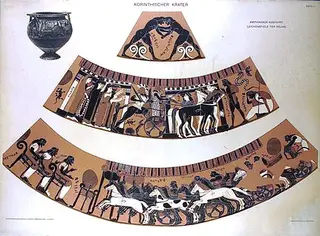
What each painter chose to show, scene by scene: Greek vase painting →