The god of the cold north wind. He lives in Thrace. He carries off the Athenian princess Orithyia and makes her his wife. The Turkish word 'poyraz' for the north-east wind comes from his name.
In brief
- According to Hesiod he is the son of Eos, the Dawn, and the Titan Astraeus. His brothers are the winds Zephyrus (west) and Notus (south).
- He carries off Orithyia, daughter of King Erechtheus of Athens, from the banks of the river Ilissus. Their sons, the winged twins Calais and Zetes, sail with the Argonauts and free the blind seer Phineus from the Harpies.
- The Turkish word 'poyraz' comes from the Greek 'Boreas'.
Family
Parents
Hesiod, Theogony 378–380
Consorts and partners
Children
To see the whole family, open the Boreas family tree → · how is Boreas related to Zeus? → · compare with someone else →
The son-in-law of Athens
According to Herodotus, when the Persians attacked Greece, the Athenians followed an oracle and prayed to Boreas, their 'son-in-law'. Soon a storm wrecked many ships of the Persian fleet. The Athenians then founded a sanctuary of Boreas beside the Ilissus.
Herodotus, Histories 7.189Boreas on Greek vases
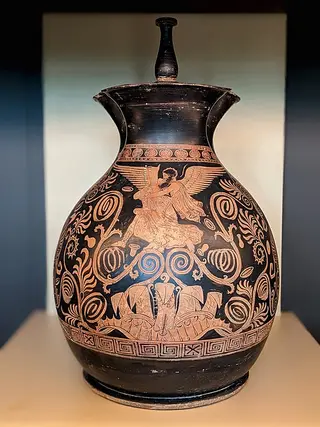
Boreas in art
8works depicting Boreas, in date order, from ancient vases to paintings of the Renaissance and after. All are in the public domain or openly licensed. Click an image for the full-size version and licence details. For scene-by-scene readings of famous vases, see Greek vase painting.


Quick questions
- Who are Boreas' parents?
- In the main account, Boreas' father is Astraeus and mother is Eos. Hesiod, Theogony 378–380
- Who were Boreas' consorts and lovers?
- The partners named in the sources: Orithyia.
- Who are Boreas' children?
- This atlas records 3 children of Boreas: Boreads, Calais and Zetes. See the family tree →
- What is Boreas' Roman name?
- In Roman mythology Boreas is known as Aquilo. All Greek and Roman names →
- What are Boreas' symbols?
- Wings, Wild hair and beard.
Ancient sources
This page is based on the texts below. Numbers refer to books and lines.
- Hesiod, Theogony 378–380, 869–871
- Herodotus, Histories 7.189
- Apollodorus, Library 1.9.21, 3.15.2
- Ovid, Metamorphoses 6.682–721