Goddess of crossroads, torches and magic. Hesiod praises her as a generous goddess honoured by Zeus; she was worshipped above all in Caria, in Anatolia.
In brief
- The daughter of the Titans Perses and Asteria, which makes her Leto's niece.
- Hesiod gives her a long hymn of praise: Zeus kept the honours this goddess had from the Titans' time and gave her a share of the earth, the sea and the sky.
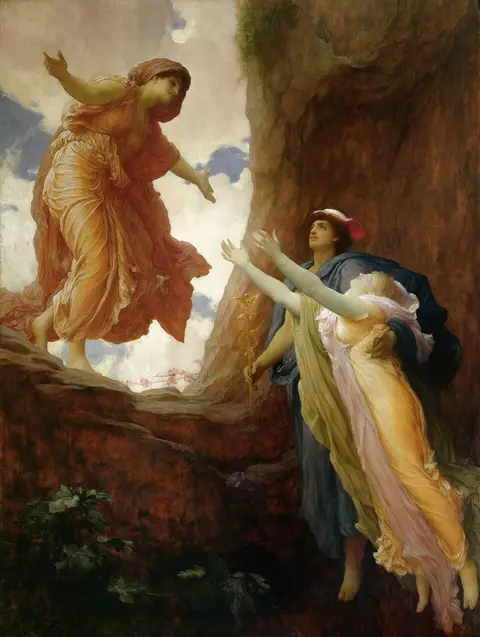
- She is one of the two who hear Persephone's cry when Hades carries her off. Holding torches, she searches with Demeter, and later becomes Persephone's companion in the underworld.
Family
Parents
Hesiod, Theogony 409–411
To see the whole family, open the Hecate family tree → · how is Hecate related to Zeus? → · compare with someone else →
Hesiod's Hecate
The lines on Hecate in the Theogony are noticeably more enthusiastic than the rest of the poem. Here she is not a witch but a generous goddess who gives plenty, victory and good fortune to anyone who sacrifices to her. Her darker side, linked with crossroads, graveyards and magic, comes to the fore in later centuries, when three-faced statues of her stood at crossroads and food was left out for her at the dark of the moon.
Hesiod, Theogony 411–452Lagina, the home of Hecate
Hecate is thought to have come from Anatolia, especially Caria. Lagina, near Yatağan in Muğla, was the most important sanctuary of Hecate in the ancient world. A sacred way linked it to the city of Stratonicea, and great festivals were held there every year. The temple frieze shows Hecate helping at the birth of Zeus (east side) and the battle of the gods and Giants (west side). Most of the frieze is now in the Istanbul Archaeology Museums.
Strabo, Geography 14.2.25Hecate in art
3works depicting Hecate, in date order, from ancient vases to paintings of the Renaissance and after. All are in the public domain or openly licensed. Click an image for the full-size version and licence details. For scene-by-scene readings of famous vases, see Greek vase painting.


Stories featuring Hecate
Quick questions
- Who are Hecate's parents?
- In the main account, Hecate's father is Perses and mother is Asteria. Hesiod, Theogony 409–411
- What is Hecate's Roman name?
- In Roman mythology Hecate is known as Trivia. All Greek and Roman names →
- What are Hecate's symbols?
- Two torches, Dog, Three faces.
- Which myths is Hecate in?
- The abduction of Persephone.
Ancient sources
This page is based on the texts below. Numbers refer to books and lines.
- Hesiod, Theogony 409–452
- Homeric Hymn 2 to Demeter 24–25, 52–61, 438–440
- Apollonius of Rhodes, Argonautica 3.1194–1224