Half-man, half-horse creatures of the mountains of Thessaly, mostly wild and drunken. Wise Chiron and kindly Pholus are the exceptions.
In brief
- According to Pindar, Ixion lusts after Hera. To test him Zeus shapes a cloud, Nephele, in Hera's likeness, and from this union comes Centaurus, who mates with the mares of Mount Pelion. The Centaurs descend from him.
- Most Centaurs are wild and uncontrollable. The wise Chiron and Pholus, who hosts Heracles, are exceptions.
- Nessus, who causes Heracles's death, is also a Centaur.
Family
Parents
Pindar, Pythian 2.21–48
To see the whole family, open the Centaurs family tree → · how is Centaurs related to Zeus? → · compare with someone else →
The Centauromachy
At the wedding of Pirithous, king of the Lapiths, and Hippodamia, the Centaurs are among the guests. Unused to wine, they get drunk and try to carry off the bride, and a bloody battle breaks out between Lapiths and Centaurs, with Theseus fighting on the Lapith side. The battle is carved on the metopes of the Parthenon in Athens and the pediment of the Temple of Zeus at Olympia. The Greeks saw it as the victory of civilisation over savagery.
Ovid, Metamorphoses 12.210–535; Homer, Odyssey 21.295–304Pholus's wine
While hunting the Erymanthian boar, Heracles is the guest of the kindly Centaur Pholus, who opens the Centaurs' shared jar of wine. The other Centaurs smell it and attack, and Heracles drives them off with his poisoned arrows. In the confusion he accidentally wounds Chiron too.
Apollodorus, Library 2.5.4Centaurs on Greek vases
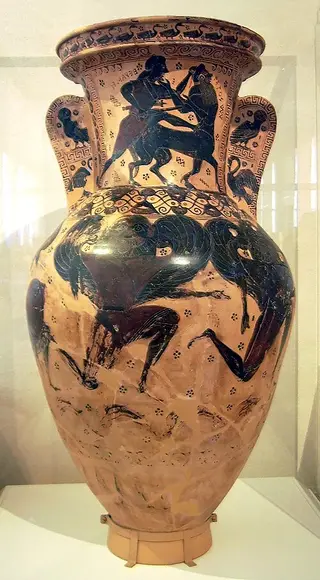
Centaurs in art
16works depicting Centaurs, in date order, from ancient vases to paintings of the Renaissance and after. All are in the public domain or openly licensed. Click an image for the full-size version and licence details. For scene-by-scene readings of famous vases, see Greek vase painting.


Quick questions
- Who are Centaurs' parents?
- In the main account, Centaurs' father is Ixion and mother is Nephele. Pindar, Pythian 2.21–48
- What are Centaurs' symbols?
- Human torso on a horse body.
Ancient sources
This page is based on the texts below. Numbers refer to books and lines.
- Pindar, Pythian 2.21–48
- Ovid, Metamorphoses 12.210–535
- Apollodorus, Library 2.5.4; Apollodorus, Epitome 1.21
- Homer, Odyssey 21.295–304