The queen who fled the Phoenician city of Tyre and founded Carthage in North Africa. In Virgil's Aeneid she falls in love with Aeneas, and when he leaves her she kills herself, cursing his descendants with endless enmity.
In brief
- Her real name is Elissa, and she is the daughter of the king of Tyre. Her brother Pygmalion murders her rich husband Sychaeus for his wealth.
- Sychaeus's ghost appears to Dido and tells her where his treasure is buried. Taking the treasure and those willing to follow her, she escapes by sea.
- On the African coast she buys from the local people 'as much land as an oxhide can enclose'. She cuts the hide into thin strips and encircles a whole hill. The name of Carthage's citadel, Byrsa ('hide'), was explained by this story.
Family
Parents
Virgil, Aeneid 1.621
Consorts and partners
To see the whole family, open the Dido family tree → · how is Dido related to Zeus? → · compare with someone else →
Dido in the Aeneid
Dido takes in Aeneas after a storm casts him onto the African coast, and through the influence of Eros, Aphrodite's son, she falls in love with him. Caught in a storm during a hunt, they shelter in the same cave, and Dido takes it as a marriage.
Zeus sends Hermes to remind Aeneas that he must go to Italy. Aeneas prepares in secret. Dido pleads, then curses him: may there never be peace between her people and his descendants. She kills herself with Aeneas's sword on a pyre.
In Virgil, Aeneas sees Dido's shade in the underworld. Without a word she turns away and goes back to her first husband, Sychaeus.
Virgil, Aeneid 1.335–756, 4, 6.450–476Another Dido
In a version older than Virgil's, as reported by the Roman historian Justin, Dido never meets Aeneas. When the local king Iarbas wants to marry her, she throws herself into the fire to stay faithful to her first husband.
Justin, Epitome of Pompeius Trogus 18.4–18.6Words of Dido
“Rise from my bones, some avenger!”
Our own plain translations: they keep the sense, not the exact words. Play “Who said it?” →
Dido in art
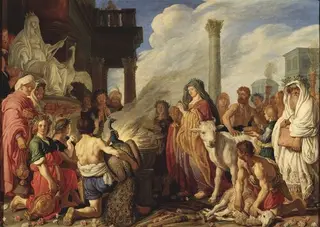
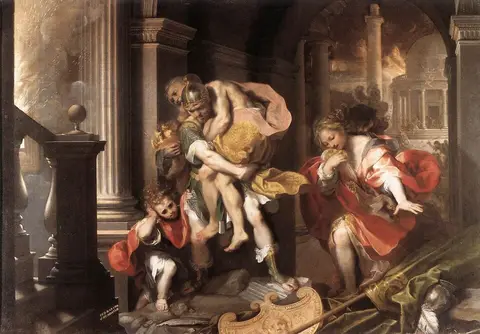
15works depicting Dido, in date order, from ancient vases to paintings of the Renaissance and after. All are in the public domain or openly licensed. Click an image for the full-size version and licence details. For scene-by-scene readings of famous vases, see Greek vase painting.


_-_Dido_auf_dem_Scheiterhaufen_-_2260_-_Bavarian_State_Painting_Collections.jpg)


Stories featuring Dido
Quick questions
- Who are Dido's parents?
- In the main account, Dido's father is Belus. The mother is not named in this account. Virgil, Aeneid 1.621
- Who were Dido's consorts and lovers?
- The partners named in the sources: Sychaeus and Aeneas.
- Which myths is Dido in?
- The journey of Aeneas: from Troy to Rome.
Ancient sources
This page is based on the texts below. Numbers refer to books and lines.