The three-bodied giant of the far west whose red cattle Heracles steals in his tenth labour.
See the tenth labour on the map →
In brief
- In Hesiod he is the son of Chrysaor, who sprang from Medusa's neck, and the Oceanid Callirhoe. Hesiod calls him 'three-headed'; later writers and vase painters show him as a warrior with three bodies joined at the waist.
- He lives on Erytheia, the 'Red Island', in the Ocean where the sun sets. Herodotus places it near Gades (Cádiz) in Spain.
- Heracles kills first the dog Orthrus and then the herdsman Eurytion with his club. When Geryon comes to rescue his cattle, Heracles shoots him with his arrows.
Family
Parents
Hesiod, Theogony 287–288, 979–981
To see the whole family, open the Geryon family tree → · how is Geryon related to Zeus? → · compare with someone else →
Through Geryon's eyes
In the 6th century BC the poet Stesichorus wrote a long poem, the Geryoneis, of which only fragments survive. They tell the story from the monster's side: Geryon's fear of death, his mother's pleading. When Heracles's arrow strikes his head, Geryon's head droops like a poppy. The Canadian poet Anne Carson drew on these fragments for her verse novel Autobiography of Red.
Stesichorus, Geryoneis (fragments, especially fr. S15)Geryon on Greek vases
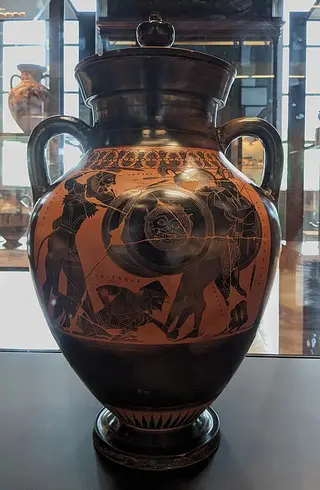
Geryon in art
3works depicting Geryon, in date order, from ancient vases to paintings of the Renaissance and after. All are in the public domain or openly licensed. Click an image for the full-size version and licence details. For scene-by-scene readings of famous vases, see Greek vase painting.


Quick questions
- Who are Geryon's parents?
- In the main account, Geryon's father is Chrysaor and mother is Callirhoe. Hesiod, Theogony 287–288, 979–981
- What are Geryon's symbols?
- Red cattle.
Ancient sources
This page is based on the texts below. Numbers refer to books and lines.
- Hesiod, Theogony 287–294, 979–983
- Apollodorus, Library 2.5.10
- Herodotus, Histories 4.8
- Stesichorus, Geryoneis