Skip to content
Mortal · Greek mythology

Narcissus

Νάρκισσος

The beautiful youth everyone loved but who loved no one. He falls in love with his own reflection in a pool and wastes away, and a narcissus grows where he died.

In brief

  1. In Ovid he is the son of the river god Cephisus and the nymph Liriope.
  2. Asked whether he will live a long life, the seer Tiresias says: 'If he never knows himself.'
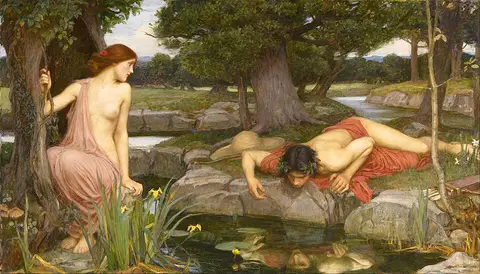
  3. He rejects the nymph Echo and many other suitors. Nemesis punishes him with unrequited love: he falls in love with the reflection he sees in the water, himself.

Family

Parents

CCephisus+ LLeiriope

Ovid, Metamorphoses 3.342–346

To see the whole family, open the Narcissus family tree → · how is Narcissus related to Zeus? → · compare with someone else →

Pausanias's version

Pausanias mentions the spring of Narcissus at Donacon in the territory of Thespiae. He finds it absurd that anyone could mistake a reflection for a real person, and reports another story: Narcissus had a twin sister who looked just like him. When she died, he gazed into the spring and found comfort in seeing her in his own reflection.

Pausanias adds that the narcissus flower was known before this story. The older poet Pamphos, he says, wrote that Kore (Persephone) was picking narcissi when she was carried off.

Pausanias, Description of Greece 9.31.7–9

Narcissism

The term 'narcissism', for excessive admiration of oneself, comes from this story. It was used by Havelock Ellis and Paul Näcke at the end of the 19th century and made popular by Freud.

Havelock Ellis, 'Auto-Erotism' (1898); Paul Näcke (1899); Sigmund Freud, 'On Narcissism' (1914)

Narcissus in art

16works depicting Narcissus, in date order, from ancient vases to paintings of the Renaissance and after. All are in the public domain or openly licensed. Click an image for the full-size version and licence details. For scene-by-scene readings of famous vases, see Greek vase painting.

Fountains of Narcissus in the Boboli Gardens, Pietro Francavilla
Fountains of Narcissus in the Boboli GardensPietro FrancavillaCC BY 3.0 · Photo: Sailko
Narcissus and Echo
Narcissus and EchoCC BY-SA 4.0 · Photo: Rigorius
Sculpture depicting Narcissus
Sculpture depicting NarcissusAD 79Antiquarium (Castellammare di Stabia)CC BY-SA 3.0 · Photo: Mentnafunangann
Ephebe
EphebeAD 150Department of Greek, Etruscan, and Roman Antiquities of the LouvrePublic domain
Genie of eternal rest
Genie of eternal restAD 300Department of Greek, Etruscan, and Roman Antiquities of the Louvre, Mazarin CollectionPublic domain · Photo: Jastrow
Narcissus, Jacopo Tintoretto
NarcissusJacopo Tintoretto · 1560National Museum in WrocławPublic domain
Narcissus, Caravaggio
NarcissusCaravaggio · 1600Galleria Nazionale d'Arte AnticaPublic domain
Echo and Narcissus, Nicolas Poussin
Echo and NarcissusNicolas Poussin · 1629Department of Paintings of the LouvrePublic domain
Narcissus, Francesco Liberti
NarcissusFrancesco Liberti · 1629Statens Museum for KunstPublic domain
Narcissus Falling in Love with His Own Reflection, Peter Paul Rubens
Narcissus Falling in Love with His Own ReflectionPeter Paul Rubens · 1636Museum Boijmans Van BeuningenPublic domain
Landscape with Narcissus and Echo, Claude Lorrain
Landscape with Narcissus and EchoClaude Lorrain · 1644National GalleryPublic domain
Narcissus and Echo, Franciscus de Neve, Frans de Neve
Narcissus and EchoFranciscus de Neve, Frans de Neve · 1660Christ Church Picture GalleryPublic domain
Platter depicting Narcissus, manufacture de Nevers
Platter depicting Narcissusmanufacture de Nevers · 1682Department of Decorative Arts of the LouvreCC0 · Photo: Shonagon
Narcissus admires his reflection in the water, Anthoni Schoonjans
Narcissus admires his reflection in the waterAnthoni Schoonjans · 1690Bavarian State Painting Collections, Electoral Gallery DusseldorfPublic domain
Painting depicting Narcissus, Nicolas Bernard Lépicié
Painting depicting NarcissusNicolas Bernard Lépicié · 1771Musée Antoine-LécuyerPublic domain
Echo Flying from Narcissus, Guy Head
Echo Flying from NarcissusGuy Head · 1795Detroit Institute of ArtsPublic domain

Stories featuring Narcissus
Quick questions

Who are Narcissus' parents?
In the main account, Narcissus' father is Cephisus and mother is Leiriope. Ovid, Metamorphoses 3.342–346
What are Narcissus' symbols?
Narcissus flower, Reflection in water.
Which myths is Narcissus in?
Narcissus and Echo.

Ancient sources

This page is based on the texts below. Numbers refer to books and lines.

  • Ovid, Metamorphoses 3.339–510
  • Pausanias, Description of Greece 9.31.7–9