A sculptor from Cyprus who falls in love with the ivory statue of a woman he has carved. Aphrodite hears his prayers and the statue comes to life. The 'Pygmalion effect' and Shaw's play Pygmalion take their names from this story.
Read the story: Pygmalion and the statue →
In brief
- In Ovid, Pygmalion is disgusted by the behaviour of the women around him and decides never to marry. He carves a woman of matchless beauty from ivory and falls in love with her.
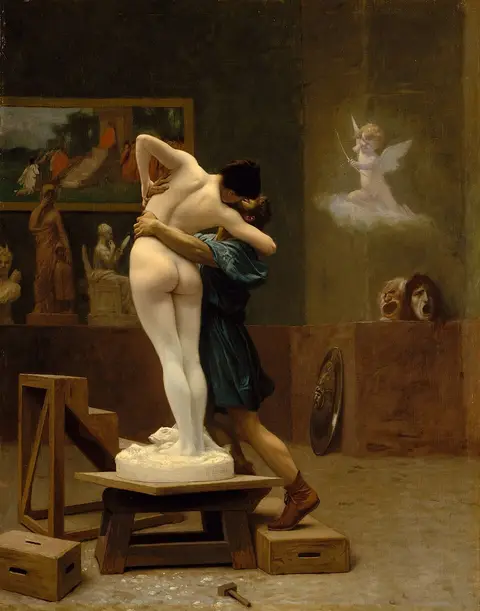
- At the festival of Aphrodite he prays at the goddess's altar: 'Give me a wife like my ivory maiden.' He goes home and kisses the statue. The ivory grows warm and soft, and the statue comes to life.
- Aphrodite attends their wedding. In Ovid their child is named Paphos (Ovid does not say whether a girl or a boy), and the city of Paphos on Cyprus bears the name.
Family
Parents
No parents: one of the first beings.
To see the whole family, open the Pygmalion family tree → · how is Pygmalion related to Zeus? → · compare with someone else →
The name Galatea, and later centuries
Ovid gives the statue no name. The name 'Galatea' became popular in the 18th century through Rousseau's stage work Pygmalion (1762).
In an older version Pygmalion is a king of Cyprus who falls in love with a statue of Aphrodite herself. The Christian writers Clement of Alexandria and Arnobius report it.
George Bernard Shaw's play Pygmalion (1913) tells of a professor of phonetics who 'remakes' a girl selling flowers in the street; it became the musical My Fair Lady. In psychology, the effect of expectations on performance is called the 'Pygmalion effect'.
Ovid, Metamorphoses 10.243–297; Clement of Alexandria, Protrepticus 4.57Pygmalion in art
14works depicting Pygmalion, in date order, from ancient vases to paintings of the Renaissance and after. All are in the public domain or openly licensed. Click an image for the full-size version and licence details. For scene-by-scene readings of famous vases, see Greek vase painting.


Stories featuring Pygmalion
Quick questions
- What are Pygmalion's symbols?
- Ivory statue.
- Which myths is Pygmalion in?
- Pygmalion and the statue.
Ancient sources
This page is based on the texts below. Numbers refer to books and lines.
- Ovid, Metamorphoses 10.243–297
- Clement of Alexandria, Protrepticus 4.57
- Arnobius, Against the Pagans 6.22