Pygmalion and the statue
A sculptor in Cyprus carves an ivory statue of a woman and falls in love with it. At Aphrodite's festival his prayer is answered: the statue comes to life.
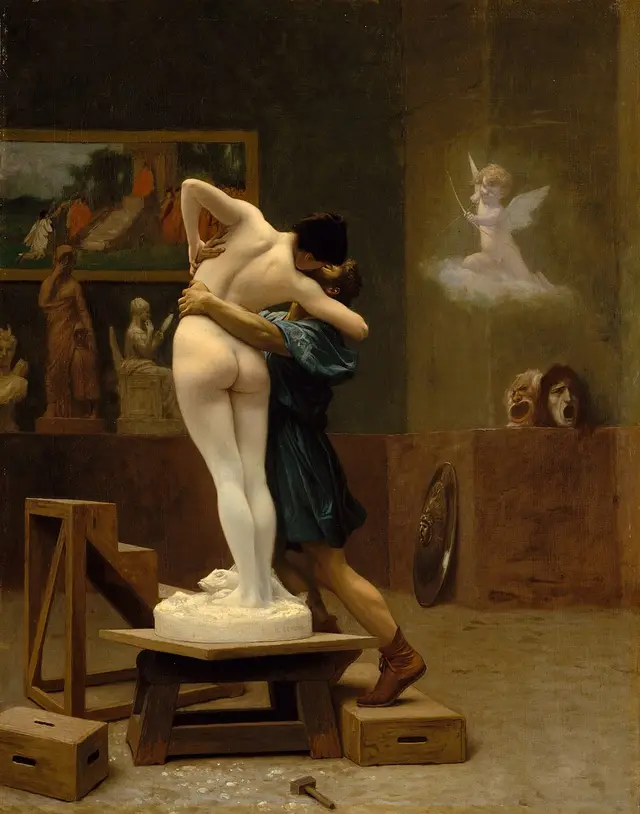
In this story
-
The ivory woman
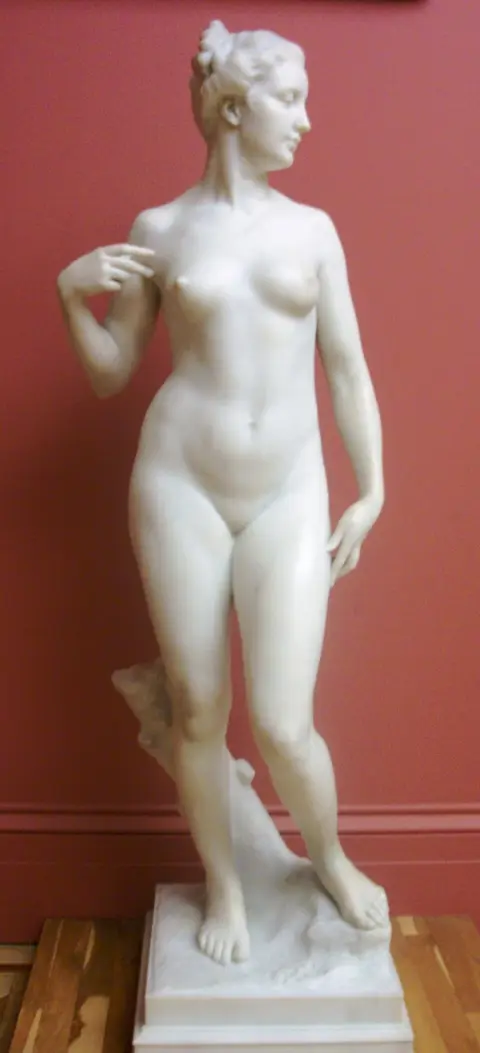
In Ovid, Pygmalion of Cyprus dislikes the women around him and lives alone. He carves a woman of matchless beauty from ivory, so lifelike that his art hides its own art.
Pygmalion falls in love with what he has made. He brings it gifts, dresses it, puts jewels on it and lays it on soft cushions.
Ovid, Metamorphoses 10.243–269 -
The prayer
Aphrodite's festival comes round in Cyprus. Before the altar Pygmalion shyly prays: 'Give me a wife like my ivory girl.' Aphrodite understands what he really means, and the altar flame flares up three times.
Back home, Pygmalion kisses the statue. Its lips are warm. The ivory softens like wax under his fingers and its veins begin to pulse. The statue opens its eyes and sees the sky and her lover at the same moment. Their child is called Paphos, the name of Cyprus's famous city of Aphrodite. Ovid does not make clear whether Paphos was a daughter or a son, and translators have rendered it both ways.
Ovid, Metamorphoses 10.270–297 -
Galatea and the Pygmalion effect
Ovid never names the statue. The name 'Galatea' became popular in the 18th century through Rousseau's play Pygmalion.
George Bernard Shaw's play Pygmalion, and My Fair Lady, adapted from it, are modern versions of the story. In psychology, the way high expectations improve a person's performance is called the 'Pygmalion effect', a name made popular by Robert Rosenthal's classroom experiment of 1968.
Ancient sources
- Ovid, Metamorphoses 10.243–297