Baucis and Philemon
In disguise, Zeus and Hermes wander through Phrygia and are turned away from a thousand doors. Only a poor old couple take them in. Their reward is to grow old together and die together.
In this story
-
A thousand doors
Ovid says Zeus and Hermes, disguised as mortals, wander the hills of Phrygia. They knock at a thousand houses asking for a night's shelter, and a thousand doors are shut in their faces.
At last they knock at a small hut with a thatched roof. Old Baucis and her husband Philemon have lived there since they were young. They are plainly poor, but they do not let it trouble them.
Ovid, Metamorphoses 8.611–636 -
The jug that refills itself
The old couple offer their guests everything they have: cabbage from the garden, smoked bacon, olives, pickled cornel cherries, cheese, eggs baked in the ashes and a cheap wine. They prop the table's short leg with a piece of broken pot.
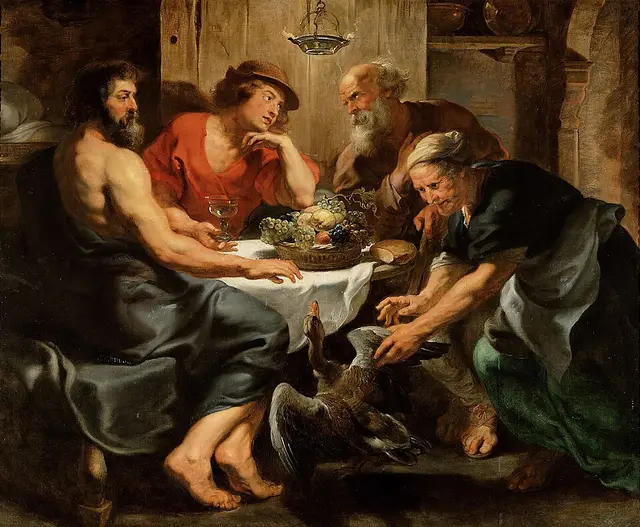
After a while they notice that the wine jug fills itself again as it empties. Afraid, they realise they are entertaining gods, and chase their only goose to kill it for their guests. The goose takes refuge with the gods, who forbid them to kill it and reveal who they are.
Ovid, Metamorphoses 8.637–688 -
The lake and the temple
The gods lead the couple up the mountain. Looking back, they see the whole village sunk under a marsh. Only their own hut is still standing, and before their eyes it turns into a temple with marble columns and a golden roof.
Zeus grants them a wish. After a brief word with his wife, Philemon names it: to be the temple's guardians, and to die at the same moment, so that neither has to see the other's grave.
Ovid, Metamorphoses 8.689–710 -
Oak and linden
Years later, very old, the two are standing on the temple steps when each sees the other sprouting leaves and branches. They say 'farewell' one last time before the bark covers their faces. Philemon becomes an oak, Baucis a linden tree.
Ovid writes that the Phrygians still point out the two trees and hang garlands on their branches.
Ovid, Metamorphoses 8.711–724
Ancient sources
- Ovid, Metamorphoses 8.611–724