The Titan condemned to hold up the sky at the edge of the world. Father of the Pleiades, and the reason a book of maps is called an atlas.
In brief
- Son of Iapetus and Clymene, and brother of Prometheus.
- Zeus punishes him by making him hold up the sky at the edge of the world, near the garden of the Hesperides.
- His daughters are the seven Pleiades, the star cluster. One of them, Maia, is the mother of Hermes.
Family
Consorts and partners
Children
* Only in some accounts.
Siblings
To see the whole family, open the Atlas family tree → · how is Atlas related to Zeus? → · compare with someone else →
The bargain with Heracles
For his eleventh labour, fetching the apples of the Hesperides, Heracles asks Atlas for help and holds up the sky for him in the meantime. Atlas returns with the apples but doesn't want his burden back. Heracles asks him to take it for a moment while he puts a pad on his head. As soon as Atlas shoulders the sky again, Heracles picks up the apples and leaves.
Apollodorus, Library 2.5.11Why a book of maps is an atlas
In 1595 Gerardus Mercator's collection of maps was published under the title Atlas. Mercator wrote that he named it not after the Titan but after Atlas, a legendary king of Mauretania whom he describes as an astronomer. The book was such a success that collections of maps have been called atlases ever since, and so is this site.
Mercator, Atlas sive Cosmographicae Meditationes (1595), prefaceAtlas in art
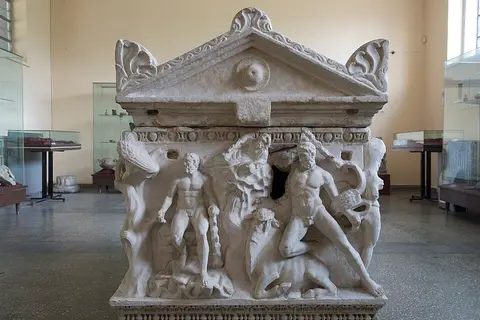
14works depicting Atlas, in date order, from ancient vases to paintings of the Renaissance and after. All are in the public domain or openly licensed. Click an image for the full-size version and licence details. For scene-by-scene readings of famous vases, see Greek vase painting.


Stories featuring Atlas
Quick questions
- How did Atlas try to trick Heracles?
- For his eleventh labour, Heracles asked Atlas to fetch the golden apples of the Hesperides and held up the sky for him meanwhile. Atlas came back with the apples but did not want the burden back. Heracles asked him to hold it for a moment while he put a pad on his head; when Atlas took the sky again, Heracles picked up the apples and left. The twelve labours map → Apollodorus, Library 2.5.11
- Why is a book of maps called an atlas?
- Because of Gerardus Mercator's map collection of 1595, titled "Atlas". Mercator wrote that he took the name not from the Titan but from a legendary King Atlas of Mauretania, whom he described as an astronomer. The book's success made "atlas" the word for any book of maps. Mercator, Atlas sive Cosmographicae Meditationes (1595), preface
- Who are Atlas' parents?
- In the main account, Atlas' father is Iapetus and mother is Clymene. Other accounts name other parents; the family box above lists them all with their sources. Hesiod, Theogony 507–511
- Who were Atlas' consorts and lovers?
- The partners named in the sources: Pleione.
- Who are Atlas' children?
- This atlas records 5 children of Atlas: Hesperides, Calypso, Maia, Pleiades and Electra. See the family tree →
- What are Atlas' symbols?
- Celestial globe.
- Which myths is Atlas in?
- The twelve labours of Heracles.
Ancient sources
This page is based on the texts below. Numbers refer to books and lines.
- Hesiod, Theogony 507–520
- Homer, Odyssey 1.52–54
- Apollodorus, Library 2.5.11, 3.10.1