The great Mother Goddess of Phrygia, in what is now central Turkey. Worshipped on mountains in a chariot drawn by lions, she was adopted by the Greeks as the 'Mother of the Gods' and identified with Rhea, and taken to Rome from Pessinus as the Magna Mater, the Great Mother.
In brief
- The chief goddess of the Phrygians, named 'Matar' (Mother) on their rock monuments and inscriptions. Her holiest sanctuary was at Pessinus, today Ballıhisar near Eskişehir.
- The Greeks took her over as Meter, the Mother of the Gods. The Homeric Hymn praises her as a goddess who delights in drums and pipes and in the cries of wolves and lions on the mountains. In time she was identified with Rhea, wife of Cronus.
- The story of her young lover Attis was told at Pessinus. Her priests, the Galli, castrated themselves in imitation of Attis.
Family
Parents
No parents: one of the first beings.
To see the whole family, open the Cybele family tree → · how is Cybele related to Zeus? → · compare with someone else →
Lions and a crown of walls
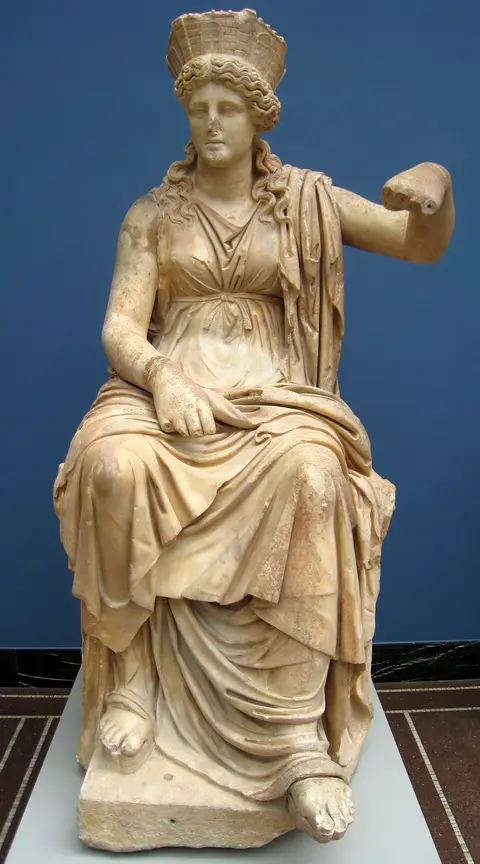
The Roman poet Lucretius describes her riding in a chariot drawn by lions, wearing a crown shaped like city walls because she protects cities. In Catullus's poem on Attis she unleashes her lions. Statues usually show her enthroned, with a lion beside her or in her lap.
Lucretius, On the Nature of Things 2.600–643; Catullus 63Cyzicus and Mount Dindymon
In Apollonius, the Argonauts set up an altar to the Mother of the Gods on Mount Dindymon near Cyzicus (today Erdek, Balıkesir) and dance in armour, beating their shields, so that she will calm the storm. Herodotus says the Scythian sage Anacharsis saw the night festival of the Mother of the Gods at Cyzicus and tried to hold it in his own country.
Apollonius of Rhodes, Argonautica 1.1078–1152; Herodotus, Histories 4.76The black stone that went to Rome
Livy tells how in 204 BC, with Hannibal in Italy, the Romans followed an oracle and brought the goddess to Rome. Her sacred black stone was carried from Pessinus and set up on the Palatine hill, where she was worshipped as the Magna Mater, the Great Mother.
Livy 29.10–29.14; Ovid, Fasti 4.247–348Stories featuring Cybele
Quick questions
- What is Cybele's Roman name?
- In Roman mythology Cybele is known as Magna Mater. All Greek and Roman names →
- What are Cybele's symbols?
- Lions, Tympanon (frame drum), Mural crown.
- Which myths is Cybele in?
- Cybele and Attis: the Mother Goddess of Pessinus · Atalanta and Hippomenes: three golden apples.
Ancient sources
This page is based on the texts below. Numbers refer to books and lines.
- Homeric Hymn 14 to the Mother of the Gods
- Pausanias, Description of Greece 7.17.9–7.17.12
- Apollonius of Rhodes, Argonautica 1.1078–1152
- Herodotus, Histories 4.76
- Lucretius, On the Nature of Things 2.600–643
- Livy 29.10–29.14
- Ovid, Fasti 4.179–372
- Catullus 63