Son of the sun god Helios. He begs to drive his father's chariot for a day, loses control of the horses and is struck down by Zeus before he can burn the world.
In brief
- In Ovid he is the son of Helios and a nymph named Clymene. Stung by the mockery of his friend Epaphus, he wants to prove that the Sun really is his father.
- Helios swears by the Styx to give him anything he asks. Phaethon asks for the Sun's chariot, and the oath cannot be taken back.
- He cannot control the chariot and sets the world on fire. Zeus hurls a thunderbolt and Phaethon falls into the river Eridanus. His sisters turn into poplar trees, and their tears into amber.
Family
To see the whole family, open the Phaethon family tree → · how is Phaethon related to Zeus? → · compare with someone else →
Hesiod's Phaethon
In Hesiod, Phaethon belongs to a different story: he is the son of Eos, the dawn, and Cephalus. Aphrodite carries him off as a child and makes him the night-keeper of her temple. The name means 'shining', and in antiquity it was also used as an epithet of the Sun.
Hesiod, Theogony 984–991Plato's explanation
In Plato's Timaeus, an old Egyptian priest says the story of Phaethon is a legendary memory of the great fires that strike the earth from time to time when the heavenly bodies drift from their courses.
Plato, Timaeus 22c–dPhaethon in art
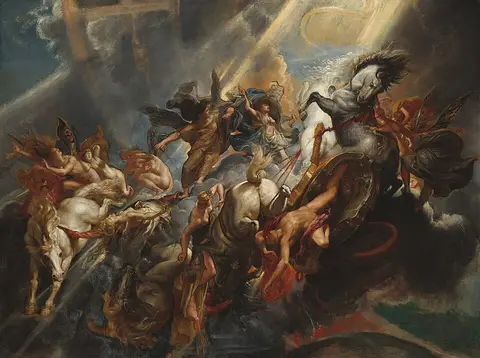
16works depicting Phaethon, in date order, from ancient vases to paintings of the Renaissance and after. All are in the public domain or openly licensed. Click an image for the full-size version and licence details. For scene-by-scene readings of famous vases, see Greek vase painting.


Stories featuring Phaethon
Quick questions
- Who are Phaethon's parents?
- In the main account, Phaethon's father is Helios. The mother is not named in this account. Other accounts name other parents; the family box above lists them all with their sources. Ovid, Metamorphoses 1.750–779
- What are Phaethon's symbols?
- The Sun's chariot, Poplar trees, Amber.
- Which myths is Phaethon in?
- Phaethon and the chariot of the Sun.
Ancient sources
This page is based on the texts below. Numbers refer to books and lines.