Apollo and Daphne: the nymph who became a laurel
One of Eros's arrows makes Apollo fall in love; the other makes Daphne flee from love. As Apollo chases her, she calls on her father and turns into a laurel tree, sacred to Apollo ever since.
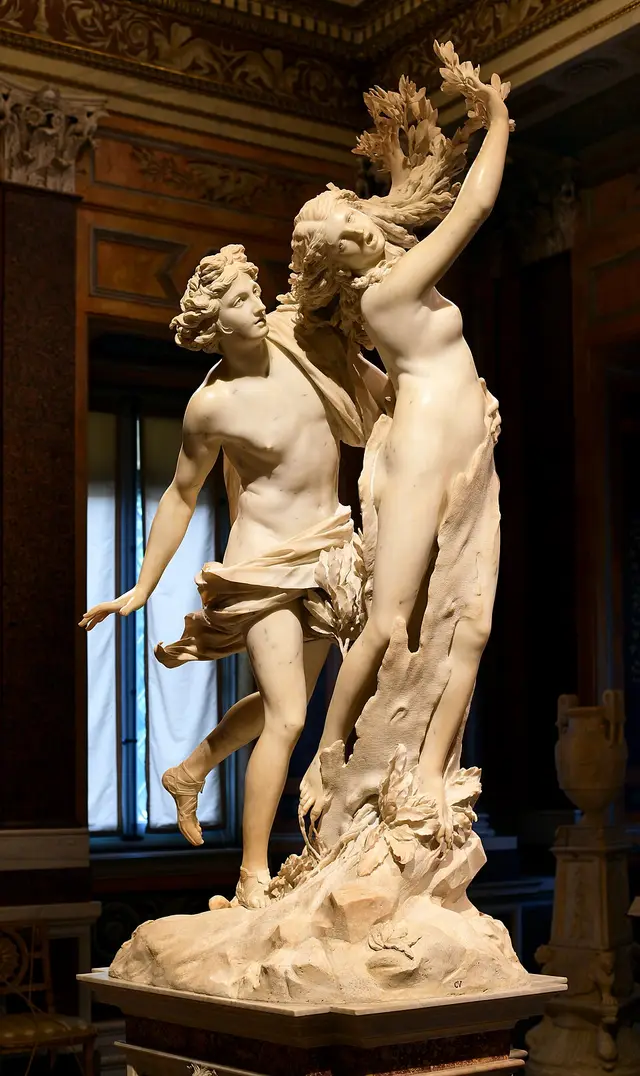
Architas · CC BY-SA 4.0 · Wikimedia Commons
In this story
-
Two arrows
Apollo has just killed the giant serpent Python at Delphi with his arrows. Proud of himself, he mocks little Eros and his bow. Eros takes revenge with two arrows: a golden one that kindles love, and a lead one that drives love away. The golden arrow strikes Apollo; the lead one strikes Daphne, daughter of the river god Peneus.
Daphne, like Artemis, wants to hunt in the woods and never marry. Her father has long since granted her wish.
Ovid, Metamorphoses 1.438–489 -
The chase
Apollo sees her and gives chase. Ovid compares it to a hound chasing a hare. As he runs, Apollo tells her who he is: lord of Delphi, son of Zeus, god of medicine and music. Daphne does not stop.
Exhausted, she reaches the banks of the river Peneus and begs her father: 'Take away this beauty of mine.' At that moment her legs become roots, her arms branches and her hair leaves.
Ovid, Metamorphoses 1.490–556 -
The leaf of victory
Apollo embraces the tree and says it will be his tree forever. Laurel will adorn his lyre, his quiver and his hair, and crown Roman generals in their triumphs.
Winners at the Pythian Games were crowned with laurel. The words 'laurel wreath' and 'laureate' come from this tradition.
Ovid, Metamorphoses 1.557–567 -
Another Daphne, and Antioch
Pausanias reports a different version told in Arcadia, where Daphne's father is the river Ladon. Leucippus, who loves her, disguises himself as a girl to join her companions. Thanks to a jealous Apollo he is found out and killed.
Daphne, a suburb south of ancient Antioch, was famous for its temple and grove of Apollo, and local tradition said the transformation happened there. The area is now the district of Defne in Hatay, home to the Harbiye waterfalls.
Pausanias, Description of Greece 8.20.2–4; Strabo, Geography 16.2.6