Apollo and Hyacinthus
Apollo loves Hyacinthus, a young prince of Sparta. While they are throwing the discus, Apollo's discus kills him. The grieving god makes a purple flower grow from his blood, its petals marked 'AI AI'.
In this story
-
The young Spartan
Apollodorus says Hyacinthus was the son of Amyclas, king of Sparta. In Ovid, Apollo loves him so much that he leaves his temple at Delphi for Sparta, sets aside his lyre and bow, carries the nets, holds the hounds and roams the mountains with him.
Apollodorus adds that the singer Thamyris also loved Hyacinthus, and was the first man to love another man.
Apollodorus, Library 1.3.3, 3.10.3; Ovid, Metamorphoses 10.162–173 -
The discus
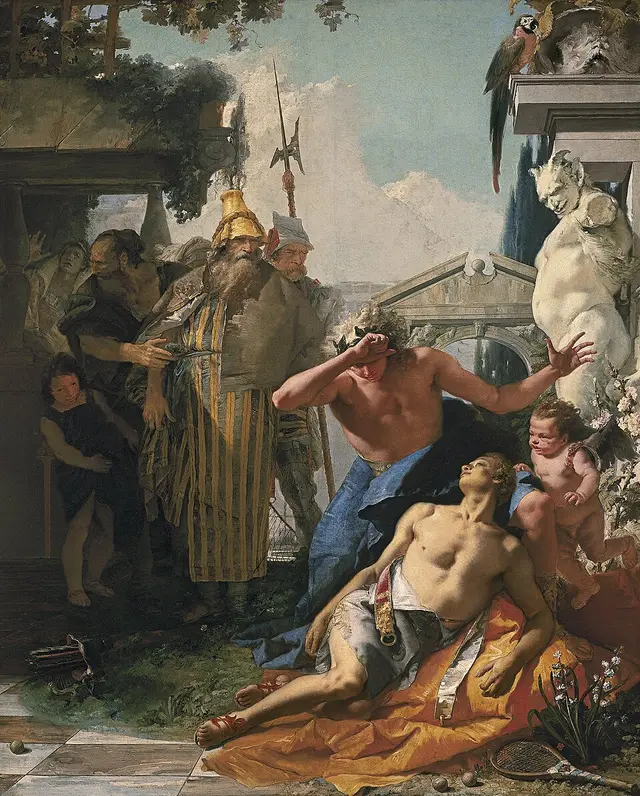
One noon the two strip, rub themselves with olive oil and begin to throw the discus. Apollo throws first; the discus parts the clouds and falls far away. Eager to play, Hyacinthus runs to pick it up, but it bounces off the hard ground and strikes him in the face.
Apollo takes him in his arms and tries to stop the blood with healing herbs, in vain. Hyacinthus's head droops onto his shoulder like a flower with a broken stem.
Ovid, Metamorphoses 10.174–195 -
A jealous wind
In Ovid the death is an accident. Later writers found a culprit: Zephyrus, the west wind, jealous of Hyacinthus, blew the discus off course.
Lucian, Dialogues of the Gods (Hermes and Apollo) -
The flower marked AI AI
Apollo laments that, being immortal, he cannot die with him. From the blood on the ground he makes a purple flower grow and writes his grief on its petals: 'AI AI', Greek for 'alas'. Ovid adds that one day the name of the bravest hero, Ajax (Aias), would be written on the same flower.
This flower is not the plant we call hyacinth today; it may have been a kind of iris or larkspur. At Amyclae near Sparta a three-day festival, the Hyacinthia, was held every summer: the first day mourned Hyacinthus, the others honoured Apollo with songs and feasts. Pausanias says the tomb of Hyacinthus lay in the base of the statue of Apollo at Amyclae.
Ovid, Metamorphoses 10.196–219; Athenaeus, Deipnosophists 4.139d–f; Pausanias, Description of Greece 3.19.3–5
Ancient sources
- Ovid, Metamorphoses 10.162–219
- Apollodorus, Library 1.3.3, 3.10.3
- Pausanias, Description of Greece 3.19.3–5
- Athenaeus, Deipnosophists 4.139d–f