Hero and Leander: the lovers of the Dardanelles
Leander of Abydos loves Hero, a priestess of Aphrodite who lives across the water in Sestos. Every night he swims the Dardanelles, guided by the lamp Hero lights in her tower. One winter night a storm blows out the lamp.
In this story
-
Two shores
At one of the narrowest points of the Dardanelles, the ancient Hellespont, two towns face each other: Abydos on the Asian shore and Sestos on the European. Hero is a priestess of Aphrodite who lives in a tower above the sea at Sestos. As a priestess she cannot marry.
Young Leander of Abydos sees her at a festival of Aphrodite and falls in love, and Hero loves him too. Her family would never allow it.
Musaeus, Hero and Leander 1–220 -
The lamp in the tower
Every night Leander wades into the sea from the shore at Abydos and swims across the strait. Hero lights a lamp at the top of her tower, and Leander swims towards its light in the dark. He swims back before dawn.
Ovid tells their love in two letters. Kept from crossing by a storm, Leander writes to Hero, and Hero impatiently writes back.
Musaeus, Hero and Leander 221–288; Ovid, Heroides 18–19 -
The winter storm
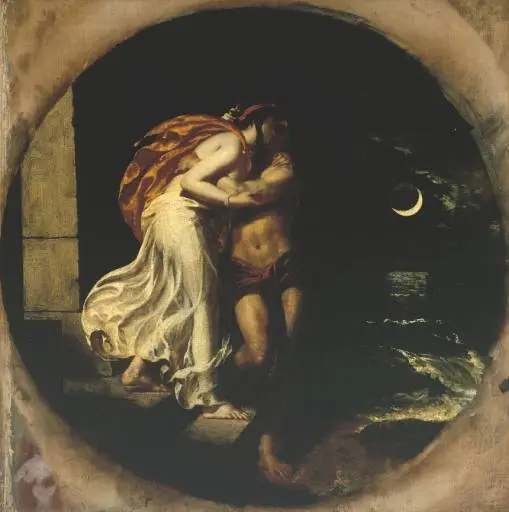
Winter comes and the strait grows wild. Leander sets out anyway. Halfway across, a gust of wind blows out the lamp. Leander loses his way and drowns in the waves.
In the morning Hero sees his body broken on the rocks at the foot of her tower. She throws herself down and joins him in death.
Musaeus, Hero and Leander 289–343 -
Lord Byron's swim
Describing the strait between Sestos and Abydos, Strabo mentions 'the tower of Hero' as a landmark sailors steered by when crossing. He does not tell the story itself; the link between the tower and Hero belongs to later tellings.
On 3 May 1810 the English poet Lord Byron set out to prove that Leander's feat was possible and swam from Sestos to Abydos. He succeeded, and wrote a short poem about it. Today's swimming races across the Dardanelles carry on the tradition.
Strabo, Geography 13.1.22; Lord Byron, Written After Swimming from Sestos to Abydos (1810)