Heracles and Omphale: slave of the Lydian queen
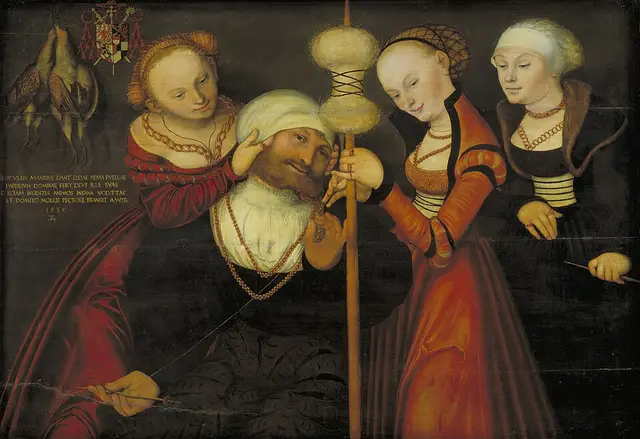
Sold into slavery to atone for a murder, Heracles serves Omphale, queen of Lydia. He clears Anatolia of bandits; later poets show him in women's clothes spinning wool.
In this story
-
A hero sold as a slave
Apollodorus says Heracles killed Iphitus, prince of Oechalia, by throwing him from the walls of Tiryns, and then fell gravely ill. He went to Delphi to be purified, but the priestess would not answer him. In his anger he began to plunder the temple and carry off the sacred tripod to found an oracle of his own. He fought Apollo until Zeus parted them with a thunderbolt.
At last the oracle answered: Heracles must be sold as a slave and the price paid to the family of Iphitus. Hermes sold him to Omphale, queen of Lydia. Apollodorus says the servitude lasted three years; Sophocles says one.
Apollodorus, Library 2.6.1–2.6.3; Homer, Odyssey 21.22–30; Sophocles, Women of Trachis 248–253 -
Labours in Anatolia
While serving Omphale, Heracles still performed heroic deeds. Apollodorus says he caught and bound the Cercopes, robbers who preyed on travellers near Ephesus, and killed Syleus, who forced passers-by to dig his vineyards, burning the vines to the roots.
Apollodorus, Library 2.6.3 -
Heracles at the spindle
Later poets added a reversal of roles. In Ovid's Heroides, Deianira writes bitterly that her husband held the wool basket and spun thread for Omphale, while Omphale wore his lion skin and carried his club.
In Ovid's Fasti, Heracles and Omphale exchange clothes. When the rustic god Faunus creeps up at night to approach Omphale, he gropes in the dark at Heracles in her dress and is hurled to the floor.
Ovid, Heroides 9.53–118; Ovid, Fasti 2.303–358 -
The kings of Lydia
Diodorus says Omphale finally freed Heracles, married him and bore him a son named Lamus. Herodotus writes that a dynasty that ruled Lydia for centuries, the Heraclids, traced its descent from Heracles.
Diodorus Siculus 4.31.5–8; Herodotus, Histories 1.7
Ancient sources
- Apollodorus, Library 2.6.1–2.6.3
- Sophocles, Women of Trachis 248–253
- Ovid, Fasti 2.303–358; Heroides 9
- Diodorus Siculus 4.31
- Herodotus, Histories 1.7